
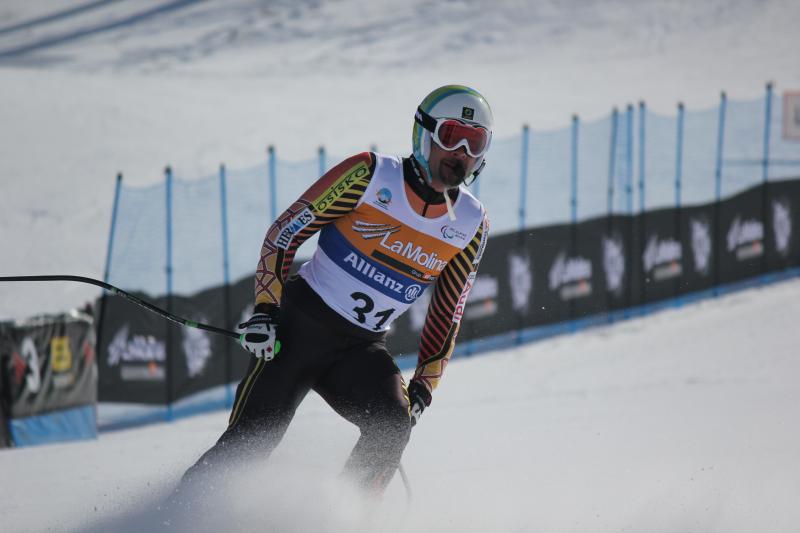
For most people, skiing brings to mind the rush of speeding down a mountain. The blur of snow, trees and mountains rushing by. For athletes who are blind and low vision, that experience is somewhat different.
For Chris Williamson, a four-time Paralympic medalist and one of Canada’s most decorated para-alpine skiers, skiing has always been about more than just the slopes—it’s been a journey of trust, teamwork, and breaking barriers, both personal and societal.
Born in Edmonton, Alberta, in 1972, Chris was born with limited vision in his left eye due to macular degeneration. By age six, he had just six percent peripheral vision and was registered with the Canadian National Institute for the Blind (CNIB).
Yet, his vision never slowed him down. Encouraged by parents who refused to let disability define his possibilities, Chris tried everything from judo to hockey, and, of course, skiing, which he first experienced at the age of three.
Over a 17-year career, Chris represented Canada in four Paralympic Winter Games, winning four medals—including gold in the men’s slalom at Salt Lake City in 2002—and dominating the IPC World Cup circuit with 105 medals, 56 of them gold.
But for Chris, the real challenge and joy came from the unique partnership that defines para alpine skiing: the relationship between athlete and guide.
Skiing as a Blind or Low Vision Athlete
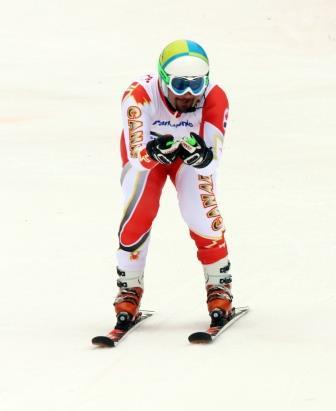
“We ski with a guide in front of us. It’s about freedom and speed,” Chris explains. “I’ve gone over 130 km/h while skiing.” He adds: “I’ll never drive, but I ski faster than most people can drive. It’s about control and being competitive.”
Para-alpine skiing classifies athletes based on vision: B3 athletes like Chris have 6–10% vision, B2 can see their hand in front of their face, and B1 has no sight or only light perception. To level the playing field, race results are adjusted based on classification, so precision and teamwork are critical.
The Role of the Guide
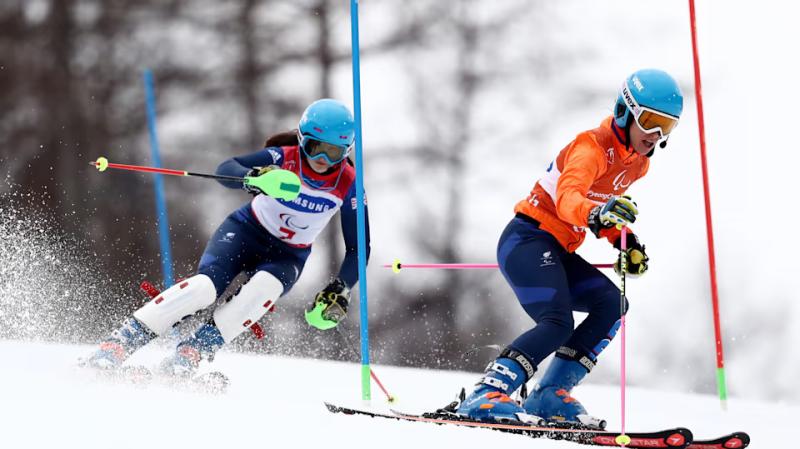
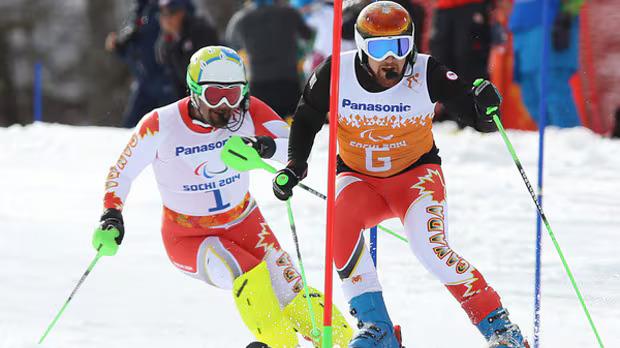
At the heart of Chris’s success is the relationship with his guide. “It comes down to personal preferences and really knowing each other’s strengths and weaknesses,” he says. “The guide skis ahead, and we communicate over radios. On steep sections, my guide would be closer; on flats, I’d catch up. It’s a lot of teamwork, and we’re a unit. Guides even receive medals, because it’s a shared effort. There’s no blame if something goes wrong; it’s about trust and synchronization.”
This partnership is built over time, through repeated practice and mutual understanding.
It’s a skill in itself to calibrate speed, distance, and communication. One that can make the difference between a gold medal and a fall.
Preparation On and Off the Slopes
Chris’s life as a Paralympian required rigorous discipline.
A typical ‘on-snow’ day during the season begins at 5:30 a.m., with skiing from 7 a.m. to noon, gym work in the afternoon, and video review sessions in the evening. Summer training focuses on running, weightlifting, and traveling to the Southern Hemisphere for on-snow practice.
Off the slopes, support systems like specialized skiing programs for people with disabilities helped Chris gain confidence, independence, and skills beyond sport.
As a youth, Chris Williams received support from CNIB for a variety of life-skills. From navigating public transit to reading in alternative formats.
These early experiences reinforced a lesson he shares for youth today: the more skills and independence you develop, the more likely you are to take on new challenges.
Overcoming Barriers
For Chris, the biggest challenges weren’t always physical.
“It’s hard to get credit for what you’ve done. People don’t readily see blindness like they do other disabilities,” he notes. Sponsorships can be difficult to secure, and societal attitudes often underestimate what someone with a visual impairment can achieve. But for him, these hurdles were never a reason to stop trying.
His advice is simple: “Try everything you have an opportunity to try. Don’t be afraid. Everybody falls, just get back up and try again. If a sport isn’t for you, try something else. No one is perfect.”
Lessons for Young Athletes and Their Guides
For parents and guides working with young athletes, Chris emphasizes courage and normalcy: “Don’t walk on eggshells. People will fall and get hurt, that’s just a part of it. Be active, have fun, and let the child try. Disability doesn’t mean inability.”
His own journey, from his early days on Edmonton slopes to Paralympic podiums, demonstrates that achievement isn’t limited by vision. It’s a combination of trust, preparation, persistence, and the willingness to push past fear.
The Takeaway
Chris Williamson’s story teaches us that barriers—whether attitudinal, physical, or mental—should never define what’s possible.
With the right guidance, teamwork, and confidence, athletes who are blind or low vision can compete at the highest level of sports. His journey is a reminder that anything is achievable if you take the leap and embrace the challenge.