
By: Shannon Kinch, Senior Manager, Legal Education and Support, CNIB, and Larissa Proctor, Executive Director, CNIB Advocacy.
Background: In May, the Government of Ontario amended a Regulation under the Provincial Offences Act to now allow police officers to issue tickets on the spot when someone denies service to a person accompanied by a guide dog, providing a more immediate enforcement response for guide dog handlers who experience discrimination. This change was more than three years in the making. Shannon and Larissa, who were closely involved in the advocacy behind it, share how it all unfolded.
People often think that changing laws and public policy begins behind the closed doors of politicians' offices, but many successful advocacy efforts begin with a simple conversation between people who see a problem that needs to be solved but aren’t yet sure what they can do about it.
For us, it all started during a frigid week in February 2023 while we were in Ottawa for a team meeting. One of our colleagues, a guide dog handler, refused to use rideshare or taxi services to travel between our hotel and the office because they didn’t have the energy to deal with the possibility of being denied a ride.
In solidarity with them, we also refused to take taxis or rideshares and instead walked back and forth to the office, luggage in tow, through bitter winter conditions, all the while wondering what could be done to put an end to guide dog access refusals.
In Ontario, when a guide dog handler is refused access, they’re told to contact their police service to report the incident, as it’s an offence under the Blind Persons’ Rights Act and police have the authority to investigate and lay charges.
Through our work with guide dog handlers, we’ve heard time and time again about the challenges they face when trying to report access refusals to police. Officers may not be familiar with the legislation or how to enforce it, and in some cases, handlers are even told that it isn’t a police matter.
So we started asking ourselves what we could do to change that. How could we help educate police so they better understood the Blind Persons’ Rights Act (BPRA) and their authority under the Act? How could we make sure guide dog handlers’ rights were actually being upheld?
With support from The Law Foundation of Ontario, we partnered with guide dog handlers and police to create a training video about the impact of access refusals and how to enforce the BPRA.
The police/guide dog handler training video, which premiered in January 2025, featured five guide dog handlers, the former chair of the Ontario Association of Chiefs of Police (OACP), Chief Jim MacSween, and officers from the Toronto Police Service, Halton Regional Police Service and York Regional Police.
You can watch the video on YouTube.
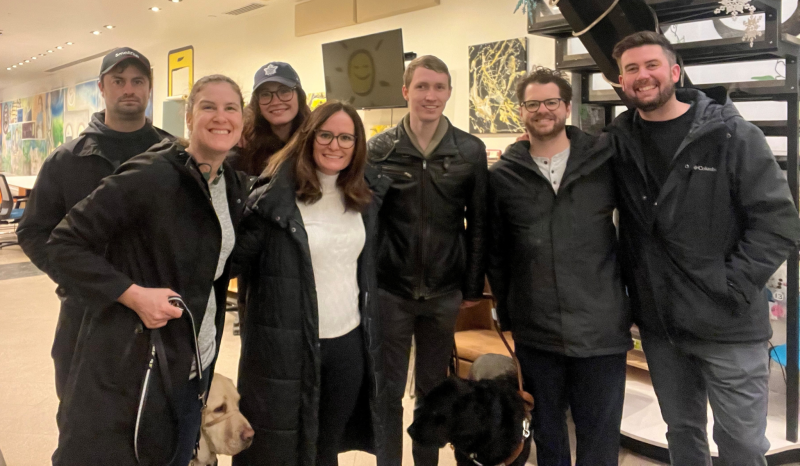
At the video premiere event in Toronto, our police partners announced new measures to educate their members, create greater awareness, and promote the video. To date, they have honoured those commitments and created further opportunities for CNIB to educate police services throughout Ontario.
But this was only the first phase of our advocacy efforts.
Through our work with police, we learned that raising awareness about the BPRA and its enforcement was only one piece of the puzzle.
Although police were able to articulate the enforcement process for the training video, our discussions with officers revealed that enforcing the BPRA was a complex process, as violations needed to be addressed under Part III of the Provincial Offences Act. This meant that officers had to submit paperwork and obtain approval from a provincial judge or justice of the peace to proceed with enforcement.
This shifted how we looked at the problem. Instead of focusing solely on educating police about the enforcement process, we started looking at how that process could be changed. If enforcing the BPRA worked more like issuing a traffic ticket, officers could take action immediately when a violation occurred.
From there, we researched the amendments that would need to be made to the Provincial Offences Act for this change to take effect. We also researched enforcement procedures in other jurisdictions where police can issue tickets for guide dog denials, including British Columbia and Australia, as potential precedents. Based on that research, we prepared a brief for the Ministry of the Attorney General regarding the proposed amendments and the rationale behind them.
Alongside our legal research, we hosted focus groups with guide dog handlers to better understand their experiences with police and what the proposed amendments would mean for them. We also asked our police partners whether they would support the proposed changes.
The views and perspectives shared with us by guide dog handlers and police were then incorporated into a second brief and brought to the attention of the provincial government, including the Offices of the Attorney General, Solicitor General, and Premier.
From advocacy to impact
On May 26, 2026, the Government of Ontario made the regulatory amendment, introduced in the Protecting Ontario’s Streets and Communities Act, 2026, strengthening enforcement of the BPRA by giving police the authority to issue tickets on the spot, with a set fine of $500, when a person’s rights are violated. Our advocacy efforts paid off!
Now begins the journey of educating police and guide dog handlers throughout Ontario about this new enforcement option and what it means for guide dog access refusals. This education also extends to the rideshare industry, where CNIB continues to work with Uber Canada to raise awareness of guide dog access rights.
"At Uber Canada, we’re working with CNIB to help prevent and reduce service animal denials through clear information for drivers, tools and support for riders, and accountability when discrimination occurs. This includes sharing details with drivers about Ontario’s newly amended regulations under the Provincial Offences Act, which allows police officers to issue an on-the-spot $500 fine for service animal denials," said Yanique Williams, Public Policy Manager at Uber Canada. "These measures build on our ongoing commitments, including mandatory information modules for drivers on their legal obligations, the voluntary Service Animal Self-ID feature, which gives riders the option to let their driver know they’re travelling with a service animal, and dedicated support when a denial occurs. There is more work to do, and our partnership with CNIB continues to help us improve the experience for riders travelling with service animals."
While we know changes to the Act won't end discrimination, our sincere hope is that these changes will not only give police a real understanding of the impacts of guide dog access denials but also result in a straightforward complaint and resolution process for people experiencing discrimination.
Learn more about Guide Dog Access Awareness Month and discover how you can help ensure guide dog teams are welcomed wherever they go. Visit guidedogchampions.ca.