
This past summer, a group of campers from CNIB Lake Joe went above and beyond expectations, venturing deep into the backcountry of Algonquin Park. With canoes loaded, tents packed, and determination as their compass, they set out on a multi-day wilderness expedition that many might not attempt.
This wasn't just a retreat, but it was also a challenge. A powerful reminder that people who are blind, Deafblind, or have low vision are not only capable of thriving in the outdoors but are the ones leading the way.
Led by wilderness guide Jen Hopkins, CNIB Program Lead, Next Generation (in partnership with Lake Joe staff and Algonquin Outfitters), the group embraced the demands of backcountry living, navigating trails, portaging gear, starting fires, and cooking over open flames.
“We were in the backcountry, away from all distractions. It was a completely immersive wilderness experience, and we were entirely self-sustaining,” said Jen. “That’s what made it so powerful. We relied on each other. We adapted. And we thrived.”
Camper Rayhan admitted they initially worried about whether they’d connect with the group. “But within minutes, I realized these were people I wanted to be around. The conversations, the laughter, the freedom, it’s something I won’t ever forget.”
Practice makes progress
“On the first day, we were just spinning in circles out on the open water,” laughed Chase. “But by the time we came back, we were the first canoe to hit shore.”
Chase wasn’t the only one who noticed the transformation.
“When we were out there, we were three canoes paddling in formation,” said Ted. “No one lagged. No one had to be towed. We figured out how to work as a team. That’s rare, even on sighted canoe trips.”
The wilderness delivered its usual physical demands: steep hikes, long paddles, and nights under the stars. 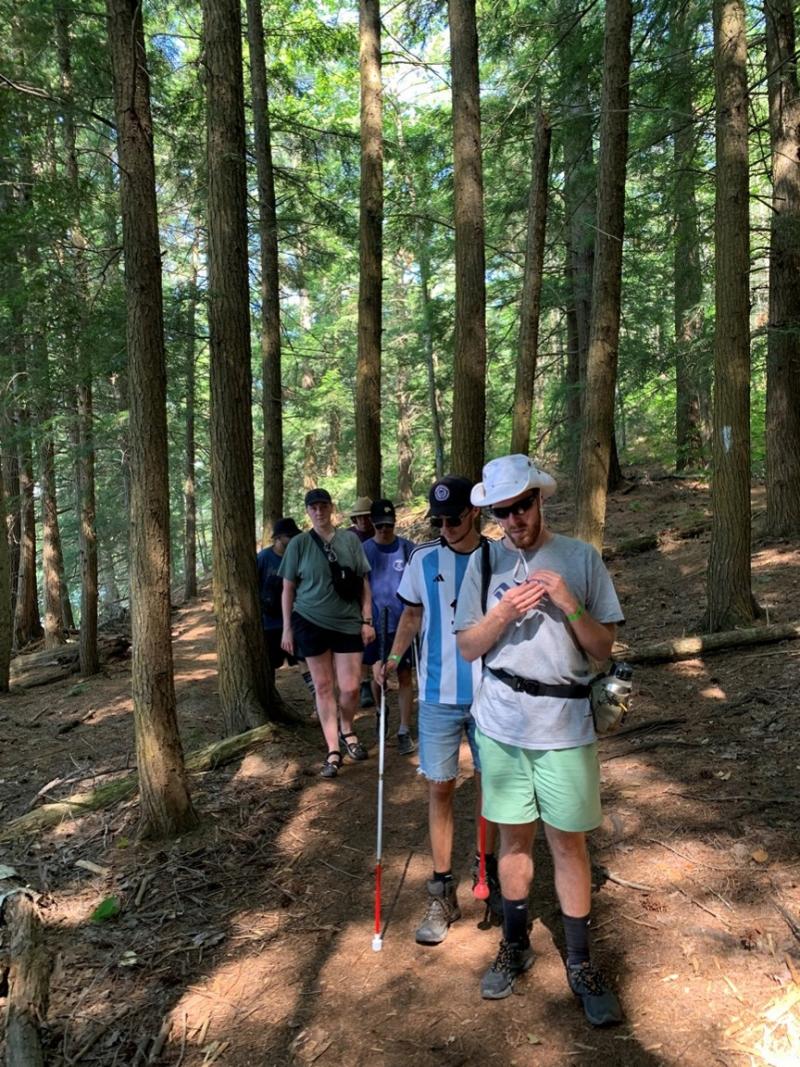
“I used to be a solo traveller,” said Chase. “After my sight loss, I thought those days were over. But this trip reawakened something in me. I feel like I can be independent again.”
For Ted, the challenge even extended to his guide dog.
“My guide dog had never done anything like this before,” said Ted. “By the end of the trip, he was jumping in and out of the canoe on his own. Honestly, he had as much fun as the rest of us.”
Before heading into the wild, campers took part in on-site training sessions at CNIB Lake Joe to learn wilderness and teamwork skills, including packing efficiently, navigating uneven terrain, and practicing paddling techniques.
“I started training months ago,” said Rayhan. “Going to the gym, preparing for portages. When I got to Lake Joe, I felt ready. I wanted to prove that my training meant something, and I did.”
Others leaned on childhood camping experience – but still valued the preparation day.
“It gave us time to figure out our team dynamic,” said Ted. “Everyone had a role. Everyone contributed.”
Jen summed it up perfectly: “The compromises (like being away from flushing toilets or a mattress) are worth it. If you want to do this, you will. And we’ll be there to support you every step of the way.”
If you’re ready to rediscover yourself, build new skills, and spend a few days truly off the grid, we encourage you to apply to join the next CNIB Lake Joe wilderness adventure.