
![Najla [left] and Salma [right] smile outdoors in front of a leafy tree and a light grey lodge-style building at CNIB Lake Joe.](/sites/default/files/styles/content_scale_width_800/public/inline-images/LJ%20Oct%204_0.jpg?itok=-IESgZMM)
Najla Nouri (left), Manager of Programs and Salma Modrika (right), Youth Program Lead, work out of CNIB’s Montreal office. They have been leading an English as a Second Language (ESL) program for francophone children and youth since 2018. This year, they introduced a pivotal expansion: for the first time, young adults participated in the ESL program.
While many people associate independence-building with childhood, the truth is that opportunities can remain limited well into adulthood, especially for people who are blind.
Najla remembers the first time she walked to the beach alone, confident and unassisted, without anyone hovering nearby. That moment shifted her entire perspective. To her, Lake Joe feels like a “resort” for people who are blind, but not in the sense of being pampered. Instead, it’s about being free: free to move, free to explore, and free from the assumptions and interventions that so often limit independence elsewhere.
For guests in the Young Adult ESL program at Lake Joe, this meant crossing provincial borders and oceans, living in a new environment, and navigating daily routines in English. Some, like Salma, embraced these challenges alongside their participants. She came not just to support others’ learning, but to improve her own English and meet peers from across the country.
Together, they practiced their English in real-life situations: ordering breakfast, chatting between activities, and even learning new words in a karate class. As Salma explained during the week, “This wasn’t just about vocabulary, it was about believing, ‘I can do this.’”
Najla and Salma weren’t the only ones embracing something new. Colombe (photo below), a psychology student from northern France, returned to Lake Joe for a second year, not out of routine, but because she hasn’t found anywhere else in the world quite like it. 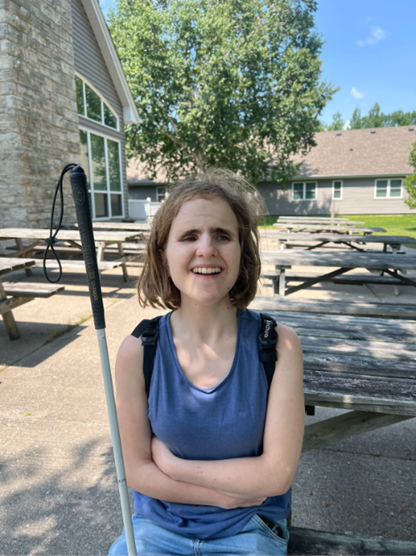
She spoke with excitement about trying water skiing, archery, pontoon cruising, and other activities she never imagined doing before. But beyond the thrill of new experiences, what moved her most was the culture of empowerment at camp.
“In France, I’ve never seen blind people leading activities,” she shared. “Here, some of the counsellors and organizers are blind; they guide us, support us, and show us what’s possible. It gives me hope.”
And while English isn’t her first language, she embraced the challenge of immersion. Compared to last year, she feels more confident, more independent, and more connected to the community. She explains that this is the type of growth that happens when you step outside your comfort zone.
For Najla and Salma, their work goes far beyond programs and activities. It’s about purpose. What unites their team isn’t just training or expertise, but a shared belief. As Salma reflected, “The best professionals in this space are the ones who see the person before the cane. That mindset changes everything. It turns the work into a calling.”