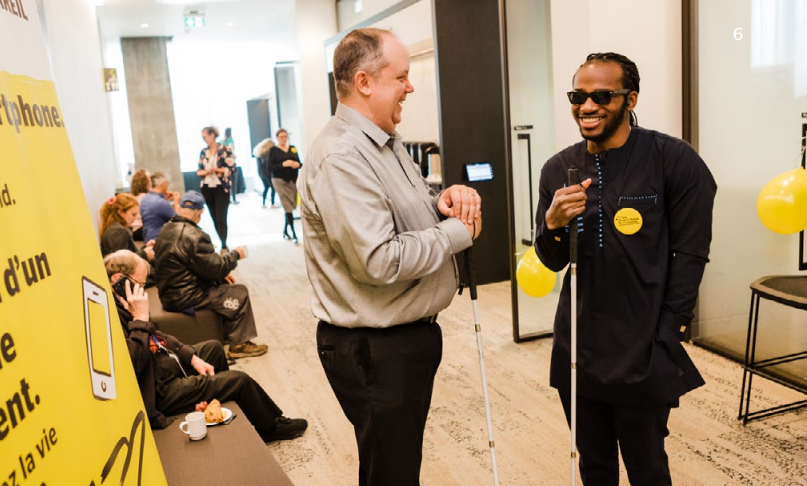
Language is very powerful. Language does not just describe reality. Language creates the reality it describes.
This is a call for inclusion.
You have an opportunity to help create a more equitable society, simply with your words. If you’re a person of influence – whether you’re a member of the media, social media creator, politician, educator, or health care professional – your words are particularly powerful.
Our understanding of inclusive language is constantly evolving. Words that we might have used years ago to describe others may no longer be acceptable. Outdated or derogatory language can make people feel excluded and create a ripple effect that negatively influences how others view and behave towards them.
When we use inclusive language that is chosen directly by the individuals we’re referring to, we help to combat ableism and change perspectives on people in positive, lasting, life-changing ways.
By adopting CNIB’s Inclusive Language Guidelines in your work, you can actively promote respectful, sensitive, and equitable communication that values and includes individuals who are blind, Deafblind, or have low vision.
Did you know?
Approximately 1.5 million Canadians live with sight loss.
Speaking and writing respectfully
Here are some things to keep in mind when speaking or writing about people who are blind, Deafblind, or have low vision…
- Everyone is unique: Blindness is not one-size-fits-all. Every person’s physical and emotional experience of it is unique. Don’t suggest everyone has the same needs, challenges, or ambitions.
- We are not “the blind”: Although the word “blind” is perfectly fine to say, the term “the blind” has its roots in patriarchal and outdated systems that positioned people who were blind as inferior and needy. Avoid this term when speaking and writing.
- Don’t overhype inspiration: Many people who are blind have achieved inspiring things and should be celebrated. But don’t position people who are blind as heroes simply for living their everyday lives. Avoid terms like “strong”, brave”, and “inspirational”.
- Use neutral language: Everyone’s experience is different, and while blindness can present challenges, many people who are blind lead full, rewarding, and very active lives. Blindness is a condition, not a catastrophe or curse. It’s not something people “suffer from” or are “afflicted by.” Don’t use language that positions people as passive victims.
- Avoid the term “visually impaired”: Although some people with sight loss are comfortable with this term and use it to self-identify, many others find it focuses on the negative and positions the individuals as “less than” their sighted peers. Because it’s considered offensive to many people, it’s best to avoid this term unless an individual specifically chooses to be referred to as “visually impaired”.
Inclusive terms for people who are blind
Before we talk about how we refer to people who are blind, it’s important to recognize one thing: Everyone who is blind is unique, and each person chooses to self-identify in their own way.
While one person may identify as blind, another may identify as partially sighted, as having sight loss, as being visually impaired, or they may use any number of other terms to describe themselves. It’s crucial that we respect the way people choose to refer to their own blindness or sight loss.
That being said, here are a few inclusive terms to describe individuals who are blind, Deafblind, or have low vision:
People who are blind
This term not only refers to people who are totally blind, but it also encompasses the full spectrum of visual disability, from mild to significant. Many people who have some degree of remaining vision embrace the term “blind” as part of their self-identity.
People who are blind, Deafblind, or have low vision
Use this phrase to refer with more specificity to the full spectrum of visual disability, including people with some remaining sight and people who are living with both blindness and hearing loss. (*Please note that the word “Deafblind” should always be capitalized as per the wishes of the community of people who are Deafblind and allies to that community.)
People impacted by blindness
This term refers not just to people who are blind themselves, but also their extended network of family, friends, and allies.
People with low vision
Use this term when you are referring specifically to individuals who are not totally blind (i.e., people who have some degree of vision).
People who are partially sighted
This term can be used as an alternative term for “people with low vision”; it is best used when describing people who have some usable vision, such as people who have remaining central vision.
People with sight loss
This term is best used when describing people who were born with sight and lost some or all of their vision later in life (i.e., people who are not congenitally blind).
People who are Deafblind
Use this term when referring specifically to people with either full or partial dual hearing loss and blindness.
Person-first vs. identity-first language
Many people who are blind prefer what’s called “person-first language” that positions the disability as secondary to the individual. In terms of terminology, this means that the person always comes before the disability, so instead of saying “blind person” you would say “person who is blind”.
However, it’s important to note that some people who are blind prefer the opposite – or what’s known as “identity-first language” – meaning that they prefer to be referred to as a “blind person” instead of a “person who is blind”.
Either way, what’s most important is that you respect the way the person chooses to refer to themselves. When in doubt, it’s best to use person-first language as some people who are blind find identity-first language to be exclusionary, especially when used by sighted individuals.
Here are a few examples of how to replace negative idioms with inclusive language...
Instead of saying...
Michael giving Tina cooking tips is like the blind leading the blind!
When the cyclist almost hit me, I screamed, “Are you blind?”
Ali knew Tim was causing trouble, but he turned a blind eye.
Jim robbed me blind at the poker game.
We’re doing our best, but honestly, we’re flying blind.
Jenn was so mad she flew into a blind rage.
He’s a good politician, but he has a lot of blind spots.
Maria has blinders on and she’s ignoring the problems that are happening.
Try saying...
Michael giving Tina cooking tips is hilarious because he can’t cook either!
When the cyclist almost hit me, I screamed, “Look where you’re going!”
Ali knew Tim was causing trouble, but he ignored it.
Jim won all my money at the poker game.
We’re doing our best, but honestly, we’re learning as we go.
Jenn was so mad she flew into a rage.
He’s a good politician, but he has a lot to learn.
Maria is ignoring the problems that are happening.
Attention journalists and storytellers!
Looking for more tips on how to report on and represent people with disabilities? Check out A Way with Words and Images, the Government of Canada’s suggestions for the portrayal of people with disabilities
About these guidelines
These guidelines were created by CNIB on the direction and feedback of people across Canada who are blind, Deafblind, or have low vision. They are designed to be a resource for people of influence and all Canadians to learn inclusive, respectful ways to write, speak about, and represent people who are living on the blindness spectrum.
If you have questions about this document, email us or call us toll-free at 1-800-563-2642 to connect with a member of our Contact Centre.